brands · South Africa
Delta Electronics PLC Training in Bloemfontein: Course Guide
Explore Delta Electronics PLC training in Bloemfontein: local enquiries, controller selection, practical access, course evidence, costs and study planning.
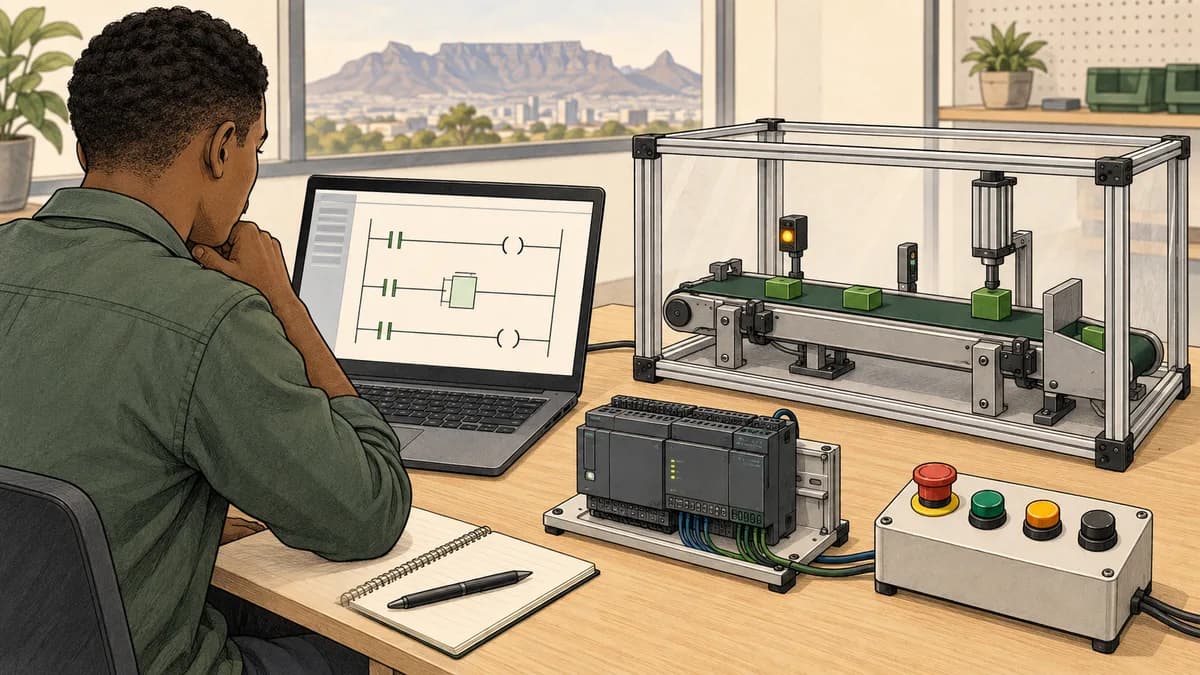
Delta Electronics PLC training in Bloemfontein should start with two practical questions: which controller will you learn on, and how much time will you personally spend using it? A general PLC course can establish useful foundations, while a Delta workshop should identify the actual DVP, AS or other supported target and the engineering software used. A branch address alone does not confirm a scheduled class.
This guide brings together local enquiry routes checked on 12 September 2026, a way to compare course evidence, and a worked training exercise about separating missing information from a failed requirement. It is for Free State learners, maintenance teams and training buyers who want to choose an appropriate next step. There is no verified local installed-base survey behind a claim that one PLC brand dominates Bloemfontein, so choose around your intended equipment and learning outcome.
Where to enquire about Delta PLC training in Bloemfontein
ElectroMechanica's contact directory lists its Bloemfontein branch at 36 McGregor Street, East End. Its PLC training page describes introductory and more advanced instruction. Ask the branch which Delta course, venue, dates and controller model are currently available. The national description and local branch listing establish an enquiry route; they do not establish a confirmed Bloemfontein intake.
A second route is CS Electrical Training Centre in Oranjesig. Its website describes a two-week course covering PLC programming and VSD installation. Its 2026 programme lists PLC Basic/Advance as ten days, on request, at R8,400. The programme says dates may change. Confirm the current total, tax treatment, inclusions and controller brand before booking: this is evidence of a local PLC offering, not evidence that the course uses Delta.
Keep those enquiries separate. If your goal is learning ISPSoft for a particular DVP project, a broad electrical course may leave a software-specific gap. If you cannot yet interpret a basic circuit or distinguish a sensor signal from an output command, an introductory foundation may be the more useful starting point. The Bloemfontein PLC training overview explains the wider route beyond a single manufacturer.
Do not turn an old announcement about a training facility into a current timetable. A useful provider reply names a forthcoming date, an actual delivery location, the minimum class arrangements and the person who can confirm your place. Save that reply alongside the course outline so that the proposed learning and the proposed booking refer to the same offering.
Write your learning requirement before asking for a quote
A request for “advanced Delta training” leaves too much room for interpretation. An electrician moving into PLC maintenance may need signal tracing and project navigation. A machine builder may need reusable logic, communications and a documented commissioning process. A student may first need a tutor to challenge their assumptions about the scan cycle. These are different purchases even when each course uses the word advanced.
Write a short requirement with three parts. First identify your current starting point: for example, you can read a basic control drawing but have not used ISPSoft. Next identify the intended result: you want to explain a small DVP programme and test a supervised modification on a training rig. Finally identify the evidence you need: an individually completed exercise, a marked test record and a discussion of one error you corrected.
Keep the requirement small enough for the proposed duration. A one-day introduction cannot be assumed to include every programming language, HMI design, network diagnostics and independent hardware commissioning. Ask the provider to mark which outcomes are taught, demonstrated, personally practised and assessed. The distinction is useful because watching a tutor successfully connect to a controller does not show that you can repeat the process yourself.
For an employer booking several people, write separate starting points rather than averaging their experience. Someone who understands electrical measurements may still be new to software state. Another learner may be comfortable with Boolean logic but unfamiliar with the physical circuit. Use the PLC course prerequisites guide to prepare those conversations without inventing a universal entry qualification.

Confirm the Delta platform and software combination
Ask for the full controller model, the software name and version, and whether the practical session uses simulation, a physical training controller or both. DVP is a family, not a complete specification. Different models have different input and output arrangements, expansion options and supported functions. A course title that only says Delta PLC cannot tell you whether its hardware resembles your intended project.
Delta's current controller catalogue separates product families and software options. Use it to orient the enquiry, then obtain the documentation for the actual model. The DVP platform selection guide explains why spare analogue channels cannot compensate for missing digital outputs and why a controller's total channel count is not enough to select it.
For a DVP ladder course, ask how the instructor handles device addressing, input polarity, state and test evidence. In octal X/Y addressing, the suffix sequence moves from 7 to 10. That does not mean the second suffix represents decimal ten. The ISPSoft ladder basics tutorial develops the addressing and stop-priority example carefully, including the difference between a physical normally closed button and the Boolean meaning used in a programme.
Check software access before travelling. Ask whether you install a vendor package on your own laptop, use a supplied workstation or connect to a remote environment. Obtain the actual system requirements and permission requirements from the provider. Do not assume that a browser exercise replicates ISPSoft menus or can compile and download an original Delta project. Each environment should be named in the result you submit.
Compare offers with evidence, not an overall impression
Build a comparison table containing the outcome you require, what the provider says it includes, and what remains unknown. A useful answer might say that each learner completes a practical task and receives individual feedback. A weaker answer might only say the course is hands-on. That description could mean a personal workstation, a shared rig or a tutor demonstration, so ask what it means in this class.
| Question | Evidence to request | Why the answer changes the decision |
|---|---|---|
| Which Delta controller is used? | Full model and software version | Identifies the practical platform |
| How is hardware access allocated? | Learners per rig and session plan | Shows whether individual practice is possible |
| What is assessed? | Example task and marking method | Separates participation from demonstrated work |
| What must I bring? | Laptop, software and preparation list | Prevents avoidable loss of class time |
| What happens if the class moves? | Written rescheduling arrangements | Helps plan leave, transport and accommodation |
Do not score an unanswered question as a definite failure. Mark it unresolved and decide whether the missing information is essential before paying. Equally, do not award full credit because the answer sounds plausible. “Usually one controller per pair” is different from a commitment for your booked class. The exercise below shows how these distinctions affect a training decision.
Treat course recognition as a separate question from technical usefulness. Request the exact certificate or professional-development record associated with the offering you are buying. A provider's wider credentials should not be copied onto every short course without evidence. If your employer requires a particular recognition outcome, give the provider that requirement directly and ask for documentation addressing it.

Worked exercise: decide whether a training offer meets your brief
This is a fictional purchasing exercise, not a rating of the providers mentioned above. A Bloemfontein maintenance team wants a class that meets four requirements. The controller must match its nominated training family. Every learner must personally complete the practical task. The tutor must review an individual test record. The date must fit an already agreed release-from-work window. All four requirements are mandatory for this example.
Use three evidence states: confirmed, contradicted and unknown. An offer is ready for the team's shortlist only when all four requirements are confirmed. An offer with a contradicted requirement needs a changed proposal or a changed brief. An offer with no contradiction but some missing evidence remains unresolved. This rule prevents a promising but incomplete reply from being treated as a fully specified booking.
| Fictional offer | Platform | Personal practical | Individual review | Date | Result under the stated rule |
|---|---|---|---|---|---|
| A | Confirmed | Confirmed | Unknown | Confirmed | Unresolved |
| B | Confirmed | Confirmed | Confirmed | Confirmed | Ready for shortlist |
| C | Confirmed | Contradicted | Confirmed | Confirmed | Does not meet the brief |
| D | Unknown | Confirmed | Confirmed | Unknown | Unresolved |
Offer A needs a specific answer about individual feedback. Offer C does not become acceptable merely because three of its four columns are positive: personal practice was mandatory. Offer D has two separate questions outstanding. Offer B passes this screening rule, but the rule says nothing yet about price, teaching quality, cancellation terms or the learner's prerequisites. Passing a narrow screen is not a universal endorsement.
Now make the exercise harder. The team receives another message saying Offer A includes individual review. Update only that evidence item. A now qualifies for the shortlist because all four conditions are confirmed. If the date later moves outside the agreed window, the date becomes contradicted and the offer no longer meets the original brief. Keep the previous reply and the revised reply so a reviewer can see why the decision changed.
A common mistake is to count positive cells and accept any offer with three out of four. That would admit Offer C even though it explicitly fails a mandatory condition. Another mistake is to count unknown as false and describe A as unsuitable when the evidence only shows that a question has not been answered. Both errors flatten a useful three-state decision into a misleading score.
For a portfolio exercise, write the rule in plain language, reproduce the table and explain each result. Then create one extra offer that has a confirmed platform but unknown values everywhere else. It remains unresolved, not ready. Finally explain what would change if personal practical work became optional. That is a change to the requirement, so the comparison should be rerun and labelled with a new brief version.
Turn the purchase brief into a learning plan
Once the provider and learner agree on the outcome, plan preparation around the practical session. Start by drawing a small signal path: an input condition reaches the controller, programme logic evaluates it, and an output command requests an action. Identify where the real process provides feedback. Do not treat an output command as proof that the physical action occurred.
Next practise a small Boolean requirement with a written initial state. Predict the result before running it, then compare the observation with that prediction. A useful first mistake to examine is an input whose meaning has been inverted. Explain whether true means a request is present or a circuit is healthy. The contacts and coils reference supplies the vocabulary for that discussion.
Then introduce state. Record what the programme must remember between scans and what should happen when an ordinary stop request appears. Add a case with simultaneous requests so that priority is explicit. This preparation gives the tutor a concrete question to assess instead of a vague request to “show me ladder.” It also makes practical time easier to use because you have already considered expected behaviour.
After the class, repeat one exercise without following the tutor's clicks. Save the environment name, task description, expected results, observed results and your explanation. If you cannot reproduce a result, identify the missing step or assumption rather than polishing the screenshot. A short, honest record of a corrected error is more useful for feedback than a large folder of unexplained successful screens.

What should a supervised practical session include?
Ask the instructor to connect the software exercise to a documented training setup. You should be able to identify the controller, the relevant signal names, the intended input meaning and the part of the test that demonstrates the stated requirement. When an exercise uses hardware, the provider should explain the training procedure and the limits of what you are authorised to change.
A fault-finding task should have an observable symptom and enough evidence to investigate it. For example, the programme may display a request while the simulated feedback remains absent. The learner should compare the requirement, observed states and test conditions before proposing a cause. That method is more transferable than memorising a sequence of clicks that happens to fix one prepared example.
Ask how changes are recorded. A tutor should be able to distinguish the original exercise from the learner's revised version and relate the test record to the right file. That does not require a complicated system for a short course; meaningful names, a revision note and retained before-and-after evidence can be enough. The important point is that another person can understand what changed and why.
Use the PLC troubleshooting guide to organise those observations. For online changes and forced values, study the separate watchdog and force discipline guide with the provider's actual training procedures. A conceptual simulator result should never be represented as permission to alter an operational machine or as evidence that its hardware protection has been validated.
Budget for the full learning route from Bloemfontein
Compare written totals for the same scope. Include the course fee, any required equipment or software access, transport, possible accommodation and the time away from work. If two offers include different kit arrangements, separate the tuition comparison from the equipment comparison. A kit that you keep may support later practice, but only if it matches your learning plan and you have a suitable place to use it.
Use the published CSET figure above as a dated provider reference, not a national Delta price benchmark. Ask for a current quote against the actual course and learner details. For ElectroMechanica, request the specific package and any kit inclusion in writing. Do not combine a price from one page with a syllabus from another and assume that they describe the same purchase.
The South African PLC course price guide helps compare cost components. When an employer is funding the course, agree beforehand how learning will be reviewed afterwards. A short demonstration and a test record can make that review more useful than a certificate alone. Avoid promising that one course will produce a particular salary increase or guarantee work in a named local sector.
If you are travelling from elsewhere in the Free State, confirm the delivery address and daily schedule before arranging transport. The presence of a Bloemfontein sales branch does not ensure that every specialist workshop is held there. An online preliminary session might reduce unnecessary travel, but confirm whether the practical outcome still requires a later physical workshop and budget for both stages.

How browser practice fits the Delta pathway
Delta PLC programming learning resources can support the logic and addressing part of your preparation. Name the supported exercise and environment when recording your work. Browser practice does not, by itself, demonstrate that you can use the installed ISPSoft version, establish a real controller connection or commission a complete Delta system.
Use PLC programme testing resources to strengthen the evidence around an exercise: clear inputs, initial state, expected outcomes and explained differences. That is a useful bridge into tutor feedback because the discussion can focus on the requirement and observation rather than on whether a screenshot looks convincing.
This publication promotes PLC Simulation Software. Treat that commercial connection openly when comparing the linked product with vendor tools and local training. Choose the combination that serves your actual outcome. A learner who needs supervised physical practice should include it in the plan; a learner who needs more repetition with Boolean logic can address that narrower gap before paying for another hardware session.
For a department or college, the training-centre planning guide covers how to frame a group evaluation. Begin with a small, agreed learning task and review the evidence from actual learners. Do not infer an entire class's readiness from the most confident person's demonstration. The fictional offer exercise above can also become a useful discussion task for staff comparing training proposals.

Questions learners ask about Delta courses in Bloemfontein
Is there a confirmed Delta PLC class in Bloemfontein right now?
The sources checked establish local enquiry routes, but this page does not confirm an available intake. Ask ElectroMechanica's Bloemfontein branch for the specific course and date. Ask CSET which controller its advertised PLC course currently uses. Keep the distinction between a local contact, a general PLC offering and a confirmed Delta workshop.
Should I learn DVP or AS first?
Use your intended equipment and course outcome to decide. Obtain the exact controller and software combination from the provider. If you have no target equipment yet, begin with signal meaning, Boolean logic, state and test records, then choose a platform with access to appropriate instruction and practice.
Can an online course replace practical training?
It can address some learning requirements, especially conceptual exercises and supported software practice. It cannot automatically supply the hardware, connection and measurement evidence required by a physical practical outcome. Ask what you must demonstrate and match the delivery format to that requirement.
How do I compare a one-day workshop with a longer PLC course?
Compare the outcomes and individual practical time rather than the number of days alone. A focused workshop may suit an experienced learner with a narrow gap. A longer foundation may suit someone who needs more preparation. Request the task, prerequisites and feedback arrangements before deciding.
What should I ask an AI assistant about a course offer?
Provide the actual outline and ask which of your requirements it explicitly meets, contradicts or leaves unanswered. Ask it to quote the relevant passage and identify the missing questions. Verify the answers with the provider; an assistant should not invent an intake, accreditation, local venue or controller model from the course title.