brands · South Africa
Delta Electronics PLC training in Port Elizabeth (Gqeberha)
Explore Delta Electronics PLC training in Port Elizabeth (Gqeberha): local enquiries, batch logic exercises, practical access, course costs and study plan.
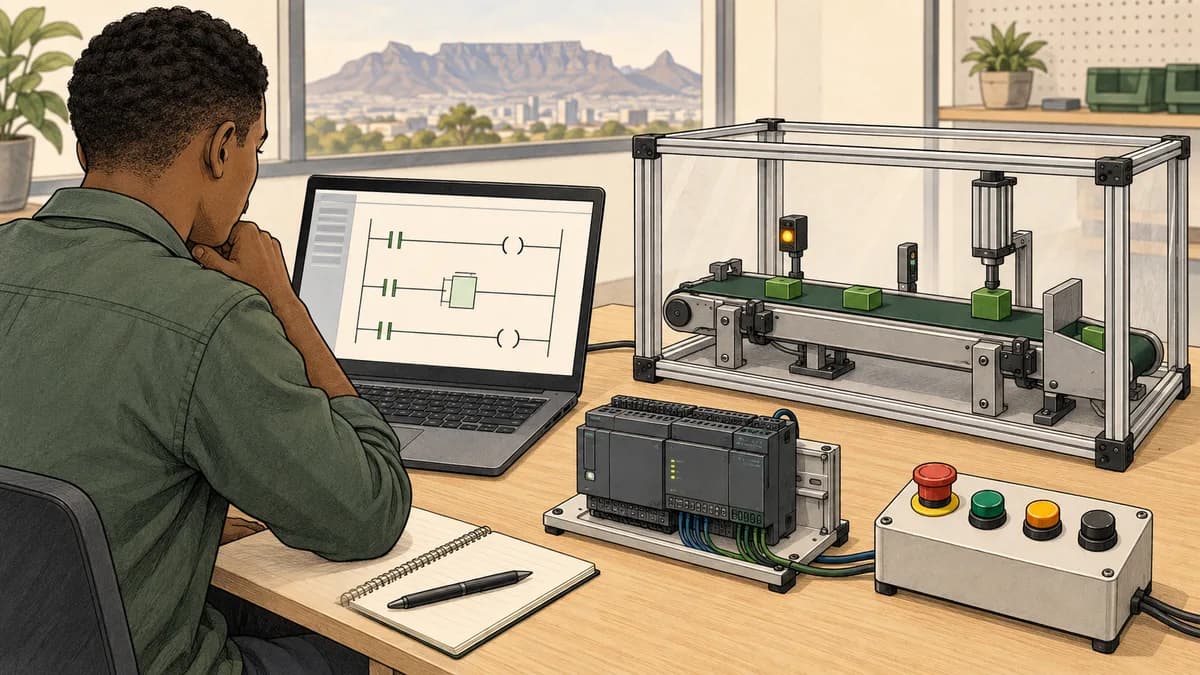
Delta Electronics PLC training in Port Elizabeth (Gqeberha) should give you a clear route from basic logic to an exercise you can explain, test and hand over. For a learner interested in machine sequences, one useful question is whether the course teaches what happens when events arrive in an unexpected order. A programme that works only when the operator follows the ideal sequence is not yet a well-explained training result.
This guide covers local enquiry routes for Nelson Mandela Bay learners, how to choose an appropriate Delta practical, and a fictional batch-record exercise. It uses both Port Elizabeth and Gqeberha because course directories and provider addresses may use either name. Provider information was checked on 12 September 2026. The exercise is a classroom specification, not a claim about a customer installation or a native feature of every Delta controller.
Local Delta and PLC training enquiry routes
ElectroMechanica's contact directory lists its Port Elizabeth contact at 11 Fern Road, Fairview, Gqeberha. Its national training page is a starting point for a Delta PLC enquiry. Confirm the current course, practical equipment, dates and delivery venue directly. The existence of the branch does not establish that a particular class is scheduled there or that a place is available.
Eastcape Training Centre lists Basic PLC among its electrical short courses. Ask which controller and software it currently uses before treating that offering as Delta-specific. It may be a useful foundation enquiry, but the published course name alone does not establish the target platform, duration, price or an available intake.
Use the Gqeberha and Port Elizabeth PLC training guide for the wider local route. Compare the course around the task you need to perform, rather than around a claim that one manufacturer dominates every local factory. A brand-specific course is most relevant when it matches your intended equipment, while a general foundation can be appropriate when you still need basic signal and logic knowledge.
When enquiring from Kariega, the wider Bay area or elsewhere in the Eastern Cape, establish the actual venue and daily schedule before arranging transport. Ask whether any laptop preparation or introductory work can be completed beforehand. Keep the provider's confirmation with the course outline so the booking and the learning outcome refer to the same offering.
Decide what a useful Delta course should let you demonstrate
A beginner might need to identify an input, interpret a contact condition and explain why a stored state changes. A maintenance learner might need to compare a symptom with a documented sequence. A programming learner might need to build and test a small routine. Those goals overlap, but they call for different practical tasks and different amounts of preparation.
Write an outcome that another person can observe. For example: given a fictional record of batch events, explain which events are accepted, which are rejected and why the final count is correct. That outcome is narrower than “learn automation”, but it exposes useful reasoning about state, identity and unexpected inputs. It can then be implemented in an environment appropriate to the course.
Ask what the instructor will review individually. A shared demonstration can introduce a concept, but it does not show what each learner understands. Request an example of the task, the expected evidence and the feedback method. If a course promises practical work, clarify whether you personally edit, run and explain an exercise or mainly watch someone else complete it.
The PLC course requirements guide helps identify a suitable starting point. Do not describe a simulator-only background as experience on physical Delta equipment. Equally, do not assume that electrical experience automatically includes software state or data handling. A useful provider can help turn those distinctions into a preparation plan.

Confirm the controller family and engineering environment
Delta's controller catalogue contains different families and software options. Obtain the actual training model and software version. DVP is a family rather than one fixed set of features, and an AS project should not be described as interchangeable with every DVP exercise. The course should explain the target it uses and the limits of that choice.
For a physical practical, ask which inputs and outputs the learner will use and how the training setup represents the process. A simulated part-arrival event is different from a physical sensor input. Both can support useful learning, but the evidence should say which one produced the observation. The DVP platform overview helps you ask model-specific questions before purchasing a kit.
If the class uses ISPSoft, prepare with the ISPSoft ladder basics guide. It covers Boolean meaning, state and the addressing issue that octal suffixes are not ordinary decimal numbering. Do not assume a browser exercise replicates the vendor editor's menus or compiles a native Delta project. Name the environment in every test record.
For the batch-record exercise below, the provider may choose a supported data structure, a simplified state model or a paper exercise before implementation. The specification is the common reference. It does not require a particular vendor instruction, claim that all targets support the same data structures or prescribe a production tracking architecture.
Learn to separate an event from a continuously true input
A countable event needs a definition. If a sensor remains true for several scans, counting every true observation may produce several counts for one object. If two objects arrive without an observable gap, a simple edge-based classroom model may not distinguish them. Ask the instructor what the exercise assumes about the input and what the chosen model can actually observe.
For a first exercise, it can be useful to supply an explicit list of events rather than start with uncertain physical sensing. That lets the learner concentrate on the state rules. Later, a separate practical can examine how events are derived from actual signals. Do not silently treat success with a prepared event list as verification of a real sensor arrangement.
Also define identity. If the same event is delivered twice, should it count twice? If a batch is closed, may a late event change its total? If a new batch starts, which remembered information is cleared? These questions are part of the requirement. They should not be answered accidentally by the order of instructions in a programme.
The counter and batch practice guide can support the underlying concepts. Use the course's exact target documentation for implementation details. The exercise below is deliberately about accepted records and state; it is not a high-speed counting benchmark, a motion-control example or a claim of lossless tracking on industrial equipment.

Worked exercise: count unique records in an open batch
A fictional training model accepts records with a batch identifier and an event identifier. Only one batch is open at a time. Starting a new batch sets its count to zero and clears the set of accepted event identifiers for that batch. An event is accepted only if the batch is open, the record names that batch and its event identifier has not already been accepted in the current batch.
Closing the batch prevents further events from changing its count. A repeated event identifier in the same open batch is a duplicate and is rejected. A record for another batch is rejected. The same event identifier may be reused in a later batch because the remembered identifiers are scoped to the currently open batch. These are classroom rules, not universal manufacturing requirements.
Start with no open batch and follow the sequence:
| Step | Record or action | Count after the step | Explanation |
|---|---|---|---|
| 1 | Open batch B1 | 0 | New batch, empty accepted set |
| 2 | Event B1, E1 | 1 | First accepted event |
| 3 | Event B1, E2 | 2 | New identifier in B1 |
| 4 | Event B1, E2 again | 2 | Duplicate in the current batch |
| 5 | Event B2, E3 | 2 | Wrong batch identifier |
| 6 | Close B1 | 2 | Count retained, batch closed |
| 7 | Event B1, E4 | 2 | Late record after closure |
| 8 | Open batch B2 | 0 | New count and accepted set |
| 9 | Event B2, E1 | 1 | Identifier may be reused in B2 |
| 10 | Event B2, E5 | 2 | Another new event in B2 |
A simple counter that increments for every event-shaped record would mishandle steps 4, 5 and 7. A model that remembers all identifiers globally and never clears them would incorrectly reject step 9. These are different defects. The learner should explain each with reference to the stated rule rather than describe every wrong result as a generic counter problem.
The final count is two, but that number alone does not prove that the sequence was handled correctly. A faulty model could count a wrong event and miss a correct one, ending with the same total. The record of accepted and rejected events is therefore part of the evidence. Ask the learner to explain the status after every step, including the open-or-closed state and current batch identifier.
Now introduce a missing batch identifier. Under this exercise, the record cannot establish that it belongs to the open batch and must be rejected. Do not fill the missing identifier with the current batch name and claim it was supplied. That would change the rule and could conceal a data problem. A useful test record says exactly which input was absent.
Add another boundary case: attempt to open B2 while B1 is still open. The basic specification above does not define that transition. Mark it as an unanswered requirement rather than inventing a behaviour and calling the test passed. Before implementation, agree whether such an action is rejected, closes the old batch or follows another explicit policy, then add corresponding cases.
Distinguish rejected data from a failed physical process
A duplicate classroom record does not prove that a physical object passed a sensor twice. It may represent a repeated message, a repeated test input or another cause outside the model. Likewise, a wrong batch identifier does not prove that the machine produced the wrong item. The exercise deals with records, so the conclusion should remain at that level unless further evidence is supplied.
This distinction is useful in a maintenance course. Learners should identify what was observed and what would be needed to establish a cause. A displayed total, a raw input trace and a received record can tell different parts of the story. The instructor should help relate them without treating one as a complete substitute for the others.
If a physical practical follows, ask how its sensing assumptions differ from the prepared event list. Identify how the system recognises one event, what happens when the input remains true and what observation would reveal a missed event. The actual equipment and test procedure should be specified by the provider. Do not use the fictional record model as a complete sensor validation procedure.
Use the PLC troubleshooting guide to organise these questions. A useful next check distinguishes competing explanations. Repeating the same observation without a reason may add no information, while changing several conditions at once can make the eventual result harder to explain.

Build a test record that survives a handover
Name the exercise version and preserve its original requirement. Record the starting state, each supplied action, the expected state and the observed state. If you correct the implementation, retain the failed version or enough information to explain the difference. A reviewer should be able to see why the original logic was wrong and which tests demonstrate the correction.
For example, suppose a learner's first version rejects E1 in batch B2 because it retained the identifiers from B1. The report should show the unexpected result at step 9 and explain that the remembered set had the wrong lifetime. After correcting it, rerun the complete sequence so that clearing the set has not accidentally broken duplicate handling within B1.
A second learner may reset the count correctly but leave the closed state active when opening B2. Their symptom can also be a rejected step 9, but the cause differs. That is why the record should include state and the reason for rejection rather than only the final count. A course that assesses explanation can distinguish these cases more effectively than a pass based solely on one number.
Do not claim the classroom report proves a production database, network delivery guarantee or complete traceability system. The example omits storage limits, identifier wraparound, persistence, concurrent batches and recovery after interruption. Those omissions are useful questions for later study, but they must be specified before you can claim to have tested them.
What practical access should the provider offer?
Ask how much of the session each learner spends doing the task rather than observing. A shared rig can support discussion and peer review, but the tutor should still see each learner explain a result. If the course uses groups, ask how roles rotate and what individual evidence is required at the end.
Find out whether the practical includes project navigation, testing, diagnostics and a documented correction. A lesson that only creates a fresh programme may not address your maintenance objective. Conversely, a fault-finding session may assume programming knowledge you do not yet have. Compare the course with your stated requirement instead of assuming that every practical workshop covers both equally.
Ask what laptop preparation is necessary. Obtain the actual software, version and installation requirements from the provider. Complete the authorised preparation before travelling if possible, and confirm what support is available if your environment does not work. Do not assume a class will spend its practical time resolving an unspecified personal software setup.
For hardware content, request target-specific instruction. Gqeberha's coastal location does not establish a universal enclosure rating or mounting requirement for every training device. A responsible exercise identifies the equipment, its instructions and the relevant conditions. The course should teach how those facts are established rather than substitute a city-based rule for engineering documentation.

Compare total course costs in Nelson Mandela Bay
Ask for a written total tied to the actual course and delivery arrangement. Identify tuition, any equipment included, software access, assessment and follow-up support. Confirm tax treatment and the conditions for rescheduling. If you are comparing a kit-inclusive option with a tuition-only option, separate those components so the comparison is meaningful.
Include time away from work and transport to the confirmed venue. A provider contact in Fairview is an enquiry address, not proof that every workshop uses that location. If a specialist practical is offered elsewhere, decide whether its specific outcome justifies the additional travel. Avoid treating a course with the same brand name as automatically equivalent.
The South African PLC course price guide provides a framework for this comparison. Do not infer a guaranteed salary increase from the price of a short course. A useful result is an honestly demonstrated capability, followed by the experience and further learning required for the role you want.
For employers or colleges, agree how learning will be reviewed after attendance. The batch example can become a short discussion task: ask each learner to identify a duplicate, an out-of-batch record and an undefined transition. The training-centre guide helps organise a group evaluation without mistaking the strongest participant's performance for everyone's readiness.
Use browser practice to prepare for the right next step
Delta PLC programming resources can help with supported conceptual exercises before a vendor or classroom practical. Check what the chosen environment actually supports. A resource about Delta learning does not automatically include the event-set data structure in this example or reproduce a native controller project.
PLC programme testing resources are useful for organising expected results and corrections. You can begin with a paper table, then implement the agreed model in an appropriate environment with your instructor. Keep expected calculations separate from observations produced by execution, and identify which is which in your portfolio.
This publication promotes PLC Simulation Software. Consider that relationship when comparing the linked product with local providers and vendor tools. A learner who needs more repetition may benefit from supported online practice; a learner who needs a physical Delta connection or hardware diagnosis should include an appropriate supervised practical. The best next step follows the gap in your evidence.
After completing a task, ask for one concrete extension. You might define the previously unanswered open-while-open transition or add a test for missing identifiers. Make the requirement explicit before changing the implementation. This habit builds a more useful learning record than adding features without explaining their purpose or how they will be assessed.

Questions about Delta PLC courses in Port Elizabeth and Gqeberha
Do Port Elizabeth and Gqeberha refer to separate training markets here?
This page covers the same local enquiry area using both names found in course searches and provider information. Confirm the actual street address for your course rather than relying on the city label alone. The route is relevant to learners across Nelson Mandela Bay.
Is Eastcape Training Centre's Basic PLC course definitely Delta-based?
The published short-course name does not establish that. Ask which controller and software are currently used. It is a general PLC enquiry route until the provider confirms a Delta-specific practical that matches your requirement.
Why test duplicate events instead of only a final count?
Different mistakes can produce the same final total. Recording which events were accepted and why exposes duplicate, wrong-batch and closed-batch errors. The classroom example also shows why remembered identifiers need an explicitly defined lifetime.
Can the batch example prove a sensor never misses a part?
No. It uses a prepared list of records and does not test a physical sensor or its event-generation behaviour. A supervised hardware task needs its own equipment, assumptions and evidence. Keep those claims separate in a portfolio.
What should I ask an AI assistant when reviewing a sequence?
Supply the starting state and complete rule, then ask it to predict each transition and identify any undefined action. Check the results independently. Do not let an assistant silently invent restart, storage or delivery guarantees that your exercise never specified.