brands · South Africa
Mitsubishi PLC Training in Pretoria: Course and Timing Tests
Explore Mitsubishi Electric PLC training in Pretoria: Gauteng course routes, native practical checks, input filtering and worked elapsed-time exercises.
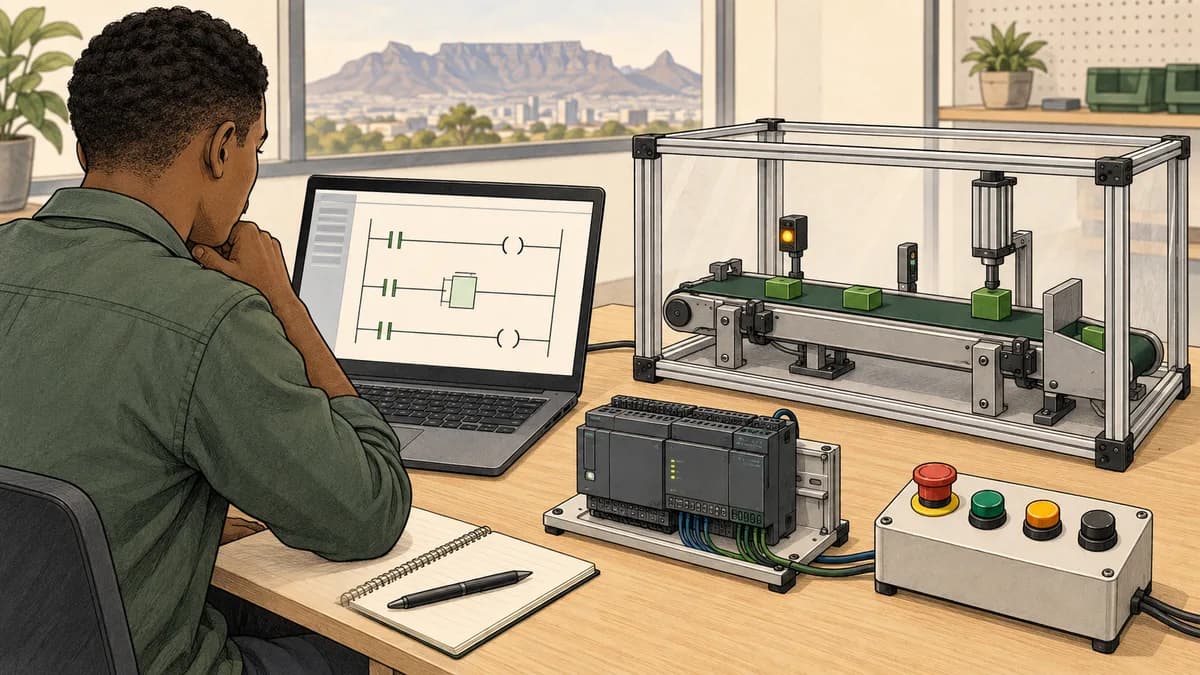
Mitsubishi Electric PLC training in Pretoria should give you a clear route from basic logic to the native controller tasks you need. Confirm the actual software, controller family, practical equipment and delivery address before booking. A general PLC course in Tshwane can provide useful preparation, while a Mitsubishi-specific practical may require a separate regional or Fourways arrangement.
This guide explains those choices and develops a fictional elapsed-time qualification exercise. It helps learners distinguish physical input response, programme observations and a deliberate application delay. The example is a teaching model, not an FX5 filter recommendation, a safety function or a verified GX Works3 project.
Compare Pretoria preparation with Mitsubishi-specific delivery
Renkalec's current course calendar gives a Clubview, Centurion venue and identifies Siemens and Delta PLC offerings. It should not be relabelled as Mitsubishi training. If you consider a general foundation course there, confirm its platform and decide which native Mitsubishi work will still be needed afterwards.
For a Mitsubishi-specific Gauteng route, the Johannesburg Mitsubishi course guide records Adroit's October iQ-F listings in Fourways, including published fee discrepancies that need confirmation. Fourways is a separate travel plan from Pretoria or Centurion. Request the exact venue, daily access and available places for the selected intake.
Adroit's iQ-R Basic course description lists controller configuration, memory, signal types, input/output processing and basic programming, with Fourways and regional delivery entries. A regional option is an enquiry route, not proof of a scheduled Pretoria class. Ask what group or delivery arrangements apply before comparing it with a local general course.
Sources were checked on 12 September 2026. Use the broader Pretoria PLC training guide to compare foundation routes. This page does not infer local controller market share, salaries or a particular employer's equipment from the industries associated with Tshwane.
Choose a practical outcome before choosing a course level
A useful learning request states what you want to demonstrate. For example, you may want to explain an input condition, configure the appropriate native project, monitor its values and prove that a programme responds according to a written timing requirement. That is more precise than asking for advanced automation training without naming the task.
Identify the controller family and exact model when possible. The iQ-R versus iQ-F comparison helps separate architecture, modules and network questions. The GX Works3 function-block guide then helps with state ownership if your exercise needs remembered information between calls.
Ask which parts of the course every learner performs individually. A shared hardware demonstration may be valuable, but the assessment should say what each participant created, changed, tested and explained. Confirm whether practical access includes a native engineering workstation and how software access works after the taught session.
For beginners, use the PLC course prerequisites guide to identify preparation needs. Boolean logic, comparisons and a clear understanding of input observations are useful foundations. The timing exercise below adds a small amount of state and arithmetic, without requiring a physical machine to understand the specification.

Input filtering and programme timing are different questions
Mitsubishi's iQ-F Basic Course training manual, input-response section describes FX5U input-response settings under the module parameters. It also explains that hardware-filter delay contributes to actual input response, with differences across input groups. Use the current hardware and application documentation for the exact target before changing a setting.
That documentation is not a reason to use one delay everywhere. A hardware input characteristic, a configurable digital filter, an input update and a programme's own qualification rule belong to different parts of the signal path. The value observed by the programme may already have passed through several stages before your logic evaluates it.
An application can additionally require an observed condition to remain accepted for a defined period before reporting a qualified state. That is the subject of this exercise. It does not specify the physical input's electrical characteristics and does not claim to detect every transition that happened between observations.
If a course advertises high-speed inputs, ask how it addresses the relationship between pulse duration, input response, observation method and the intended task. A longer filter may reject unwanted changes but can also affect wanted signals. The correct choice comes from the actual requirements and supported configuration, not from the general idea that more filtering is always better.
Define an elapsed-time classroom contract
The model receives a Boolean Condition, a GoodQuality flag and a timestamp in milliseconds from one monotonic classroom clock. The test traces use nondecreasing timestamps. The clock has no rollover in this exercise. Repeated evaluations at the same timestamp are allowed, but they add no elapsed time.
A condition qualifies after at least 300 milliseconds from the first accepted true observation in the current uninterrupted observation run. Every observation in that run must have good quality and Condition true. A false condition or bad quality clears the run and makes Qualified false immediately at that evaluation.
The maximum permitted gap between successive observations is 150 milliseconds. A gap greater than 150 breaks the run. If the new observation is good and true, it starts a fresh run at its own timestamp. A gap exactly equal to 150 is allowed. This is a fictional observation policy, not a recommended network interval or Mitsubishi input-filter setting.
At the first accepted true observation, elapsed time is zero. Qualified becomes true only on an evaluation at which the accepted elapsed time reaches or exceeds 300 milliseconds. There is no separate background event that changes the result between evaluations. This makes the model's observation boundary explicit.
The output describes this contract's accepted observation history. It does not prove that the physical signal remained true at every instant between samples. That stronger claim would need a suitable acquisition method and additional evidence. Keep the distinction visible in the test record.
Trace a normal run and the exact threshold
Begin with no active run and Qualified false. Supply good true observations at 0, 100, 200, 299 and 300 milliseconds. All successive gaps are within the allowed maximum. The start timestamp remains zero throughout the run.
| Observation time | Condition | Quality | Elapsed in current run | Qualified |
|---|---|---|---|---|
| 0 ms | True | Good | 0 ms | False |
| 100 ms | True | Good | 100 ms | False |
| 200 ms | True | Good | 200 ms | False |
| 299 ms | True | Good | 299 ms | False |
| 300 ms | True | Good | 300 ms | True |
The difference between 299 and 300 tests the requirement's “at least” boundary. A strict greater-than comparison would qualify late. A rounded display that shows both values as 0.3 seconds can conceal the distinction, so retain the integer millisecond observations in the evidence.
Now evaluate the model several more times at timestamp 300 with the same accepted true input. Qualified remains true, but the elapsed time stays 300. The evaluation count is not a clock. Likewise, three true evaluations at 0, 10 and 20 milliseconds do not qualify the condition merely because there are three of them.
A programme that increments a presumed 100 milliseconds on every call would incorrectly qualify that 20-millisecond sequence. The counterexample explains why an assumed scan period must not be silently substituted for measured or explicitly supplied elapsed time.

Test an observation gap that breaks continuity
Start again with good true observations at 0 and 100 milliseconds. The next observation arrives at 400 milliseconds. The 300-millisecond gap exceeds the allowed 150, so the earlier run is broken. The observation at 400 starts a new run with elapsed zero and Qualified false.
Continue with good true observations at 550 and 700 milliseconds. Both gaps equal the permitted maximum. The elapsed times in the new run are 150 and 300, so Qualified becomes true at 700. It must not become true at 400 by subtracting the obsolete start timestamp of zero.
| Observation time | Gap from previous observation | Current start | Qualified |
|---|---|---|---|
| 0 ms | First observation | 0 ms | False |
| 100 ms | 100 ms | 0 ms | False |
| 400 ms | 300 ms | 400 ms | False |
| 550 ms | 150 ms | 400 ms | False |
| 700 ms | 150 ms | 400 ms | True |
This model treats a large observation gap as insufficient continuity evidence. It does not claim that the physical condition became false during the gap. The distinction between unknown history and observed false is useful when reviewing a test: both can break this qualification run for different reasons.
For a different requirement, the allowed gap might change or be removed. That is a specification revision, not a reason to ignore the current rule. Update the expected table and explain what the revised model can and cannot establish before comparing results.
False and bad-quality observations reset the run
Suppose the condition has qualified at 300 milliseconds. A good false observation at 350 clears the start timestamp and makes Qualified false. A good true observation at 400 starts a new run at 400. The earlier elapsed time must not carry across the false condition.
A bad-quality observation also clears the run, even if its numeric or Boolean field happens to contain true. For example, use good true observations at 0 and 100, then bad quality at 200. A good true observation at 300 begins again with elapsed zero. The model should not qualify at 300 by treating the bad-quality field as an accepted true sample.
Continue that new run with good true observations at 400, 500 and 600. It qualifies at 600. Every interval in the accepted run is within the 150-millisecond limit. This trace tests both quality handling and recovery, rather than only checking that bad quality produces an immediate false output.
The communication troubleshooting guide helps relate quality and observation questions to a broader investigation. A real implementation needs a defined source for GoodQuality; the classroom flag does not appear automatically merely because a variable is Boolean.

Write the model so its assumptions remain visible
One conceptual implementation stores the run's start timestamp and the previous observation timestamp. On each evaluation, it first checks whether the gap breaks the run. It then applies quality and condition rules. If the new observation is accepted true and no run is active, it starts a run at the current time. Finally, it compares elapsed time with 300 milliseconds.
The order matters when a gap-breaking observation is itself true. Clearing the old run and starting a new one in the same evaluation gives elapsed zero. Retaining the old start gives a false qualification. Clearing the run but refusing to start a new one until another sample arrives would instead delay the new run unnecessarily under this contract.
This explanation is algorithmic, not native GX Works3 code. A real implementation must select suitable time types and instructions, define clock behaviour and document scheduling. The timers and counters guide provides general preparation, while the applicable Mitsubishi manuals establish the actual native semantics.
Do not assume a timer's display, an input filter and a log timestamp all use the same clock or update at the same moment. Identify each observation source before drawing timing conclusions. A test that does not record where its timestamps came from is difficult for another learner to reproduce.
Diagnose credible wrong implementations
The first defect is counting calls instead of elapsed time. Use the 0, 10, 20-millisecond sequence to expose it. The second is forgetting to reset on a false observation. Use a qualified run followed by false and then true, and check that the new run begins from zero.
The third is accepting bad quality because the condition field still contains true. Use the interruption at 200 milliseconds and the recovery sequence ending at 600. The fourth is allowing an overlarge gap to preserve the old start. Use the 0, 100, 400, 550, 700 trace.
A fifth defect is an off-by-one threshold comparison. The 299/300 pair exposes it. A sixth is using greater-than-or-equal for the gap rejection when the specification permits exactly 150. The observations at 550 and 700 catch that mistake in the gap trace.
Choose these tests because each separates the intended rule from a plausible wrong version. Repeating a normal demonstration many times does not provide the same coverage. The PLC troubleshooting guide develops the broader habit of connecting each observation to a specific hypothesis.

Make the Pretoria course assessment concrete
Ask the provider whether each learner can implement and test a comparable timing task in the actual native environment. Supply the requirement first and request predicted results before the practical begins. A good assessment includes normal behaviour, a boundary, an interruption and a deliberately wrong implementation to diagnose.
Record the exact controller, software version, project revision and timing observation method. If the instructor demonstrates physical input response, keep that evidence separate from the application qualification exercise. They are related parts of the learning route, but one does not automatically validate the other.
If a GOT screen is used, show the current condition, quality, run start and qualification state during the exercise. The GOT screen-design guide helps structure that display. A single indicator labelled Stable may hide whether the condition is false, unavailable, still timing or already qualified.
For learners commuting from Pretoria or Centurion to a confirmed Fourways class, agree the full timetable and any required preparation. The useful learning time begins more smoothly when software access, equipment and prerequisites are settled before arrival. Do not infer an on-site Pretoria practical from a general regional-delivery entry.
Compare cost, access and the next learning step
Use a written quotation for the exact course intake. Check software access, materials, equipment sharing, assessment and tax treatment together. The South African PLC course price guide helps organise the comparison. A historical or conflicting webpage price should not become the basis of a firm study budget without confirmation.
If you need a formal recognition outcome, request evidence for the exact offering and resulting document. This guide does not treat general electrical preparation, a branded short course and a qualification as interchangeable. Describe your employer's requirement clearly so that the provider can respond to the actual need.
For a training department, define which activities require individual native access and which can be prepared through general exercises. The training-centre evaluation guide provides a relevant route for that discussion. A useful programme can combine preparation and supervised practical work while keeping the evidence from each component clear.
Questions about Mitsubishi PLC training in Pretoria
Is a general Centurion PLC course Mitsubishi-specific?
Not unless its confirmed offering says so. The Renkalec calendar reviewed here identifies other controller brands. General study may still prepare logic and electrical foundations, but native Mitsubishi configuration and software work should be confirmed separately. Use the actual syllabus rather than the city name to decide fit.
Can I attend a Mitsubishi course in nearby Gauteng?
The Johannesburg guide records a Fourways enquiry route and dated iQ-F listings. Confirm the selected intake's availability, venue and current quotation. A course outside Pretoria can be suitable if its practical scope matches your needs, but travel and access should be part of the decision.
Is a 300-millisecond qualification the same as an input filter?
No. In this exercise it is an application rule applied to timestamped observations. Physical and configurable input filtering happen elsewhere in the signal path. The number 300 is a fictional teaching requirement, not a recommended FX5 parameter value or a claim about native timer behaviour.
Why does a long observation gap restart the exercise?
The declared contract requires gaps no greater than 150 milliseconds for a continuous accepted observation run. A larger gap breaks that evidence. It does not prove the physical input became false. The new accepted true observation starts a fresh run, which then needs its own 300 milliseconds to qualify.
Can I prepare this exercise before buying hardware?
Yes, the requirements and traces can be studied without a controller. This site is commercially connected with PLC Simulation Software; its Structured Text learning resources provide related general preparation. Check current supported features. They do not establish a native implementation of this model or validate an FX5 input configuration.
What should I include in a portfolio?
Include the contract, timestamp source, predicted traces and observed results. Show at least one wrong implementation and the test that distinguishes it. Mark paper reasoning, general simulation and native practical observations accurately. The work can support a technical discussion, but does not establish production competence or guarantee an employment outcome.
Finish with a requirement that another person can test
Keep the timing threshold, permitted observation gap and reset rules on the same page as the results. Include exact-boundary cases so that words such as at least and greater than remain testable. Add a short note explaining that accepted sampled history is not proof of every physical transition between observations.
The PLC programme testing resources offer a next step for general practice. Take the resulting questions to the native course provider and ask how its equipment, instruction and assessment will help you resolve them. That gives your Pretoria learning plan a clear purpose and an evidence-based way to judge progress.
